

When people ask me what separates a great esports coach from a decent one, I usually say the same thing.
Now it may be cliché, but I often say that the best coaches I’ve come across aren’t the people who decided esports seemed like an interesting career. No, not at all. The best coaches are the people who competed seriously themselves and learned what happens when a game starts demanding more from you than mechanical skill.
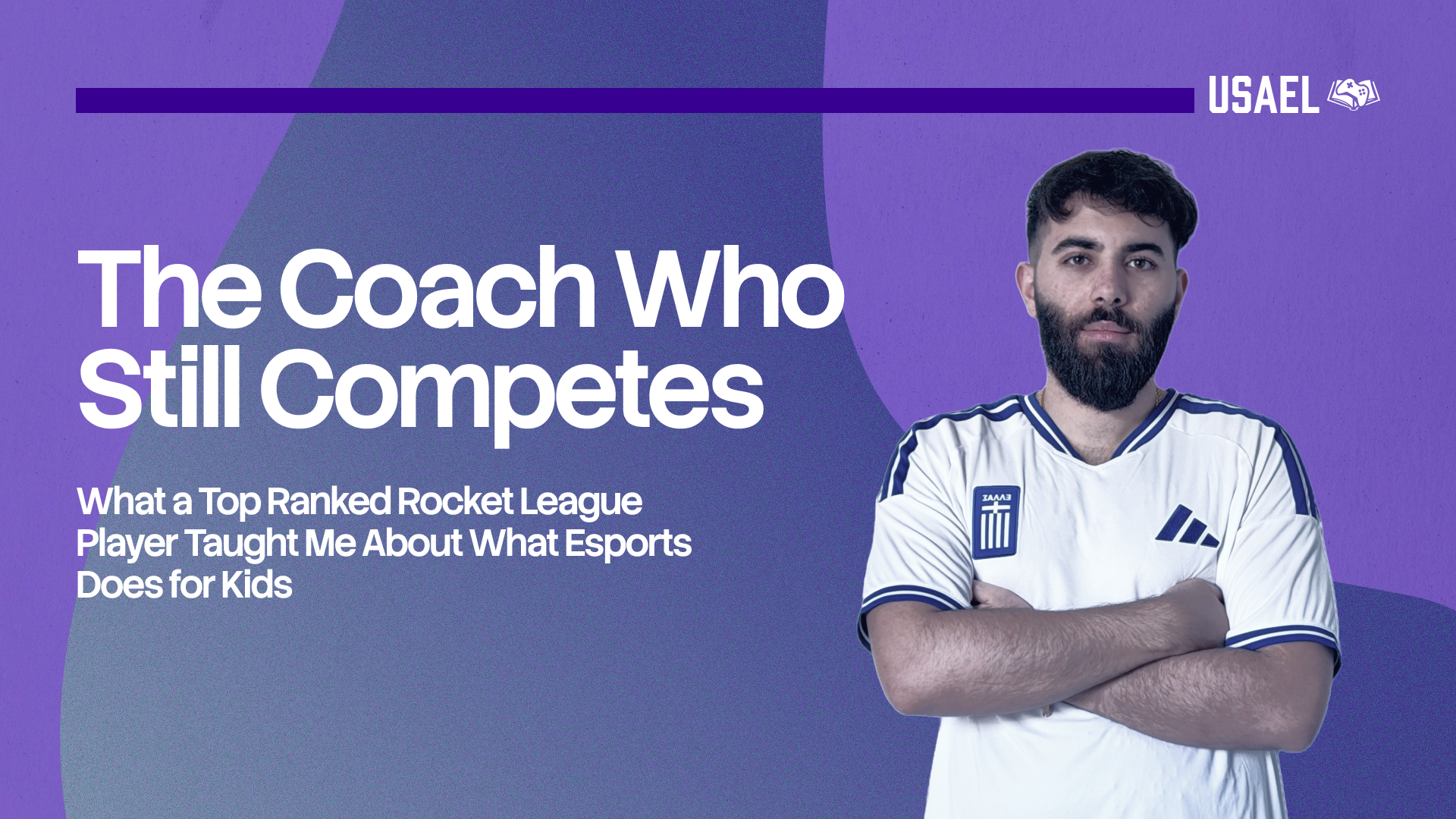
Among the many coaches at USAEL, Giannis is one of the best examples of that. He has been in the top 100 in Rocket League since Season One in 2015, still competes for his national team today, and currently coaches five school and university programs through USAEL. Today's piece centers on a recent conversation I had with him about what years of serious competition taught him, and how he now uses those lessons to change the way students approach the game.
What Does Competing at the Top Level Teach You?
When I spoke with Giannis, he said one of the biggest lessons he took from competing at the top was learning how to stay calm under pressure. It is a skill he now works to instill in his players because the ability to perform when the stakes rise extends far beyond an esports match.
For example, a peer-reviewed study published in the International Journal of Gaming and Computer Simulations found that top esports competitors face the same psychological strain as professional athletes. In fact, the researchers identified 51 separate stressors, the same kinds that footballers and rugby players deal with in a big game. Giannis learned to handle those stressors one tournament at a time, years before he started coaching.
People cannot handle pressure. I personally thrive, and I love pressure. I cannot live without pressure. That's why I have pressure on myself even when there's none. Being able to do what you know and being capable under pressure. I feel like that's going to help you so much in life.
A coach who has felt that pressure in real competition can teach it differently from someone who has only read about it, which is why we are deliberate about who we put in front of students.
What Does He See Change in Students Participating in Esports?
After nearly a decade of coaching, Giannis has watched students become more confident communicators and more dependable teammates. This is often because the USAEL program keeps asking them to practice those behaviors until they become normal.
In his classes, Giannis has seen shy players start out barely speaking in meetings and finish the season calling plays for the team after he had them talk on comms every practice until it stopped feeling scary. He has also worked with players who struggled with their temper and gradually learned to take feedback without lashing out. Over time, he has watched students become more willing to speak up and better able to control their reactions while finding their place on a team.
I've had kids that would be shy, and I would manage to get them more involved; not be so in their head, not talking to people. People that had anger management issues, just teaching them how to work within a team and how to be respectful. Those kinds of changes really stayed with me.
For some players, that improvement can also have a financial payoff since more US colleges fund esports rosters every year, including Rocket League, and Giannis has watched students improve enough to go from being overlooked by recruiters to earning scholarships.
I've had them being in a rank that no way they would be getting a scholarship, to getting to a rank that eventually got a full ride.
What Is the Difference Between Gaming at Home and Competing in a Program?
The biggest difference between gaming at home and competing in a school esports program is that one is recreational (gaming at home) while the other is structured (gaming at school) around expectations.
To put it into perspective, at home, a student can stop whenever they get frustrated, blissfully ignore feedback, or decide they don’t feel like playing that day. In a program, this mindset doesn’t fly… because teammates are relying on them. Not to mention they have a coach that expects them to show up ready to contribute.
Giannis sees that structure surrounding expectations changing how students approach the game, since competition starts requiring preparation and accountability alongside mechanical skill. This uniquely gives coaches opportunities to work on habits students may never have to confront while playing alone.
Just gaming can be purely fun. Competition is way, way different. It's not exactly like a job, but it's definitely something you cannot just do for the sake of doing. You've got to be there. You’ve got to listen. You have got to try and be a better person.
How Schools Should Measure Whether a Program Is Working
Giannis doesn't judge a program primarily by its win-loss record because many of the changes he looks for happen before they ever show up on the scoreboard. He looks for signs that students and coaches are treating improvement seriously.
I don't think winning or losing is always a good depiction of if we're doing things right. If you see that the coach is trying, the players are trying, they're doing VOD reviews, working together, having meetings, and they're always trying to get better. I think this is what's important.
For a school, those behaviors say more about what students are learning than a tournament result does. After all, a team can lose and still have students becoming better prepared and more receptive to coaching while taking greater responsibility for the people around them.
Giannis has also seen that development come full circle, with students who once needed constant guidance eventually becoming the ones helping newer players.
I've had kids that started with me knowing nothing, and now they're the ones teaching the younger players. Seeing that full circle, that's the best part of the job for me.
For him, that is another sign the program is working. A student who once needed coaching is now confident enough in what they have learned to pass it on to someone else.
What Would He Tell a Parent Who Is Still Skeptical?
From the outside, most parents see the screen time and little else. I hate to say it, but what they miss is the discipline it builds and the doors it can open, which is the side Giannis knows well.
When someone worries that gaming simply takes time away from school or other responsibilities, he tells them it is fine as long as the student keeps everything else in order first, then points to what the game gave him personally.
Growing up in Greece with an Arabic parent, he learned much of his English by playing online with people around the world. He now speaks English fluently alongside Greek and Arabic, and he credits gaming with helping him develop a skill that became useful well beyond the game.
I would say the biggest thing is balance. As long as your child is managing everything outside of gaming — personal hygiene, school homework, whatever the case may be — there shouldn't be any issue with gaming. The reason why I speak English is because of gaming to some extent. It can help you in so many ways.
So, Giannis’s point isn't that gaming automatically helps a student develop skills like communication or self-discipline. No, his point is that those skills can grow when gaming becomes structured competition under a coach who expects them to show up and improve.
See What This Looks Like in Your School
Giannis is one example of the kind of coach we want students learning from at USAEL. We look for people who understand competition at a high level but can also turn that experience into better habits for the students in front of them.
That is how an esports program becomes more than scheduled game time. Students still compete and work toward scholarships, but they are also learning how to respond to pressure, accept coaching, and take responsibility for a team. If you want to see what that kind of program could look like in your school, book a demo with our team.